· Updated
AI Visual Inspection on Woven Bag Lines: What It Catches — and What It Misses
By the Reylong Engineering Team
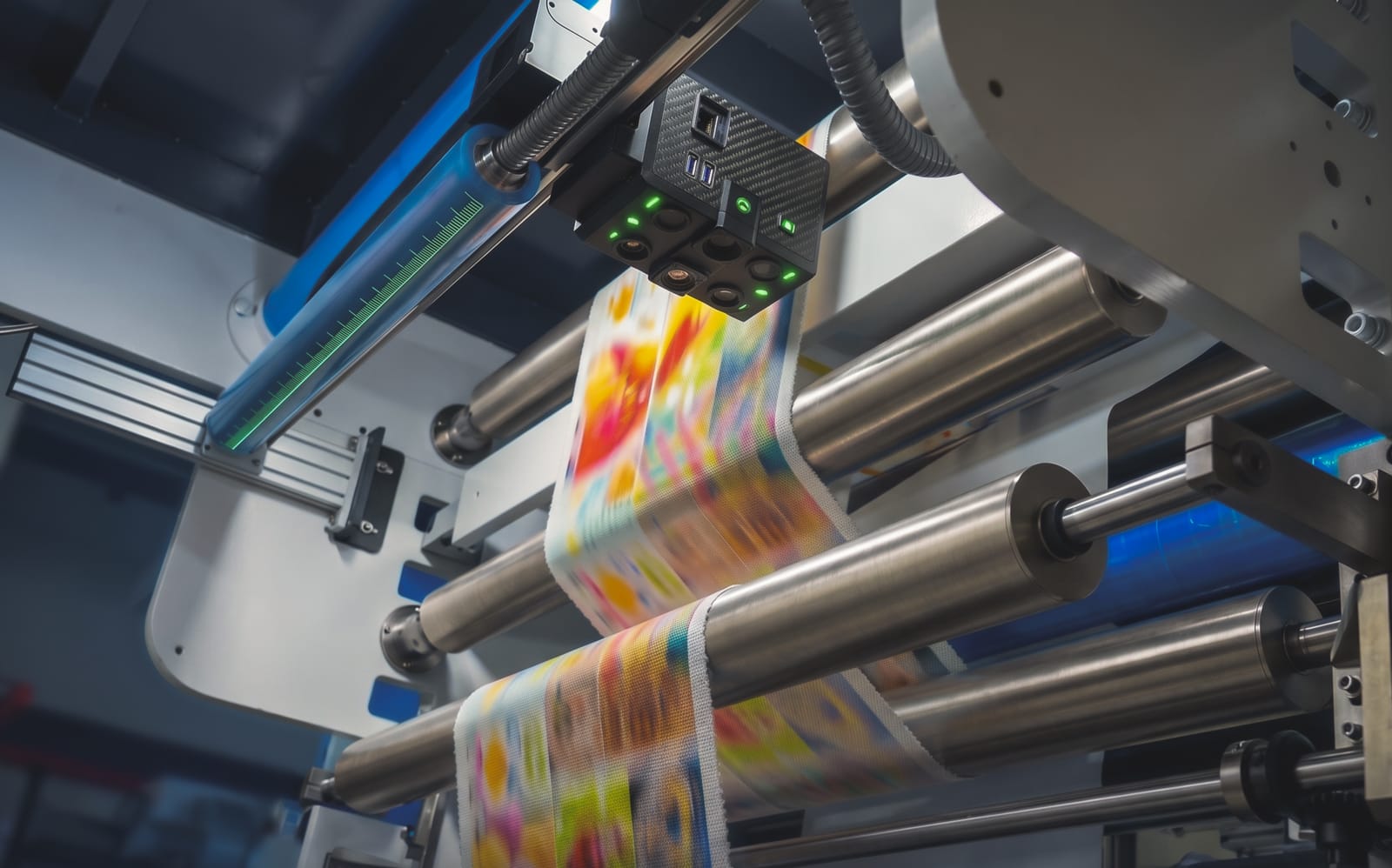
An AI vision system on a woven bag line reliably catches visible, recurring defects — registration drift, ink skip and blur in the print; broken filaments, weave holes and fuzz in the fabric; skipped stitches and cut-point offset in processing — at full line speed, with a defect recall target above 95%. What it does not do is correct those faults by itself, judge subjective colour quality the way a customer's eye does, or see defects the camera physically cannot see. This guide draws that line precisely, because the industry conversation around "AI inspection" rarely does.
Why woven PP defeated machine vision for so long
Classic machine vision is a rule engine: define a uniform background, flag anything that deviates. That works on cast film because film is uniform. A woven substrate is the opposite — thousands of tape crossings per square metre, each one an edge with its own shadow and local contrast. Point a threshold-based system at woven PP and it will flag the weave itself, everywhere, forever.
This is why inspection on woven bag lines stayed manual long after film printers had 100% web inspection as a checkbox option. The change is the model class: a convolutional neural network (CNN) does not compare pixels against a fixed reference — it learns the weave texture as the normal state, in the way an experienced inspector's eye does, and flags deviations from that learned normal. The texture that broke rule-based vision becomes background.
The practical consequence: modern systems deploy few-shot, building a working baseline from as few as around 50 reference samples of your actual fabric and artwork, rather than the thousands of labelled defect images conventional training required. On a product that changes SKU weekly, that difference decides whether the system is usable at all.
The three defect families vision handles today
Rey Long's AI-Powered Machine Intelligence inspects for three families of faults, all at full line speed:
- Printing defects — registration drift, ink skip, blur, smearing. On a line running 25–40 bags/min, a recurring print fault caught on the second bag instead of at end-of-shift is the difference between two scrap bags and a scrapped pallet.
- Material defects — broken warp or weft filaments, weave holes, surface fuzz. These arrive with the fabric roll; catching them at the machine means the fault is charged to the right process instead of surfacing as a customer claim.
- Processing defects — skipped stitches, cut-point offset, uneven hems. These are the machine's own faults, and they are the ones where an immediate alert prevents a drifting parameter from quietly producing an hour of rework.
What the accuracy numbers actually mean
Two numbers matter, and they pull against each other. Recall is the share of real defects the system catches; Rey Long specifies 95%+ recall as a design target, and the honest qualifier is that the achieved figure is application-dependent — it varies with fabric, artwork, lighting and which defect classes you care about, which is why it is established during commissioning on your product rather than quoted from a datasheet. Precision is the share of alerts that are real; its inverse is the false-reject rate. False rejects matter more than they sound, because an inspection system that cries wolf trains operators to ignore it, at which point its recall is irrelevant — and unlike a human threshold, a model's threshold is written down, so you can review it and move it.
For comparison, on the human side: a Sandia National Laboratories study of visual inspection reliability found inspectors correctly rejected 85% of defective items — and incorrectly rejected 35% of acceptable ones. That work examined precision manufactured parts rather than packaging, so it is an analogy for a bag line rather than a measurement of one; what transfers is that manual inspection loses on both sides at once. The camera's advantage is not superhuman perception on any single bag — it is that bag ten thousand gets the same inspection as bag one. We compare the two approaches in detail in the manual-vs-AI guide.
The unglamorous part: cameras and light
A vision system is an optical instrument first and a model second, and industry guidance is blunt on the ranking: lighting decides more inspection projects than camera resolution. Three realities on a woven bag line:
- Continuous webs want line-scan cameras synchronised to an encoder, building a seamless image of the moving web instead of stitching overlapping snapshots.
- Laminated fabric is glossy. BOPP lamination turns the surface into a partial mirror; light geometry (and where needed, polarisation) has to be engineered so the camera sees the print, not the reflection of the factory ceiling.
- The weave has depth. Low-angle light that makes a broken filament cast a visible shadow is the difference between detecting it and not — no model recovers information the optics never captured.
What AI inspection does not do
Three limits, stated plainly.
It does not fix the fault. The vision system detects and alerts; the correction loop for print registration — vision driving the servos to null out colour misalignment without an operator — is a direction the industry is moving in and one Rey Long is exploring, but it is not a deployed capability, and we will not describe an intention as a product. The vision-to-servo closed loop Rey Long does run today is Dynamic Error Compensation, which reads the Eye-Mark and corrects cut and seam length toward a ±1 mm target, against roughly ±5 mm of practical drift on fixed-length cutting. That is a length loop, not a colour loop — the distinction is spelled out in the registration guide.
It does not judge colour like a customer. The model flags deviations from the reference — a drifting registration, a missing colour. Whether a slightly denser red is still acceptable brand red is a colorimetry question (and ultimately a human one); a vision system is not a spectrophotometer.
It does not see what the camera cannot see. A fold hiding a stain, the inside of a tubed web, a defect on the back of the fabric when only the front is instrumented — coverage is defined by camera placement, decided at system design. This is why the assessment phase of a deployment starts from your defect history, not from the hardware catalogue.
The short version
AI vision earns its place on a woven bag line by doing one thing relentlessly: watching every bag at line speed for the visible, recurring faults that drain margin — and alerting a human while the count is still two, not two thousand. It deploys few-shot from ~50 samples, runs on edge hardware with no cloud dependency, and retrofits onto existing lines — the retrofit guide covers what that involves. What it is not is a closed-loop colour corrector or a replacement for human judgement — and a vendor who claims otherwise is describing an ambition, not a shipping system.
Talk to Rey Long's engineering team about inspection on your fabric, artwork and defect history.
Frequently asked questions
What defects can AI vision detect on woven bags?
Three families. Printing defects: registration drift, ink skip, blur and smearing. Material defects: broken warp or weft filaments, weave holes and surface fuzz. Processing defects: skipped stitches, cut-point offset and uneven hems. The common thread is that all of these are visible, recurring faults — exactly the kind a camera watching every bag at line speed is good at, and exactly the kind a human eye stops catching reliably once it has been watching the same web for a long stretch.
How many sample images does the AI model need before it works?
A working baseline can be built from as few as around 50 reference samples, because the model deploys few-shot: it learns what a good bag looks like from a small set of known-good examples plus whatever defect examples exist, rather than requiring the thousands of labelled images a conventionally trained model would. The exact number depends on the fabric, the print artwork and the defect classes that matter to you — a busy six-colour print needs more references than a plain bag with a two-colour logo.
Can AI inspection replace human quality control?
It repositions it rather than replacing it. In a Sandia National Laboratories study of visual inspection reliability, inspectors correctly rejected 85% of defective items and incorrectly rejected 35% of acceptable ones — losing on both sides at once. That study looked at precision manufactured parts rather than packaging, so it is an analogy for a bag line and not a measurement of one; but the camera takes over the task humans are demonstrably bad at: watching every bag, all shift, without fatigue. What stays human is judgement: setting the quality standard, deciding what to do when the system alerts, and the subjective calls a camera cannot make. In practice this shifts staffing rather than eliminating it — one operator can supervise up to four machines instead of two.
Why is woven fabric harder to inspect with cameras than plastic film?
Because the fabric itself looks like noise. Classic rule-based vision works by flagging anything that deviates from a uniform background — and a woven substrate is never uniform: every tape crossing creates edges, shadows and local contrast that a threshold-based system reads as thousands of false defects. A CNN model handles this because it learns the weave texture as the normal background and flags deviations from it, which is why AI inspection became practical on woven PP years after it was routine on film.
Does the vision system need internet or cloud connectivity?
No. All inference runs on edge hardware installed at the machine — an industrial PC or embedded AI accelerator — with near-zero latency and full offline resilience. Integration with the machine happens over standard industrial protocols (OPC-UA, Modbus, MQTT), so the system works in factories with limited networks or strict data-security policies that keep production data on site.