· Updated
Retrofitting Edge AI Inspection onto an Existing Bag Line: A Practical Guide
By the Reylong Engineering Team
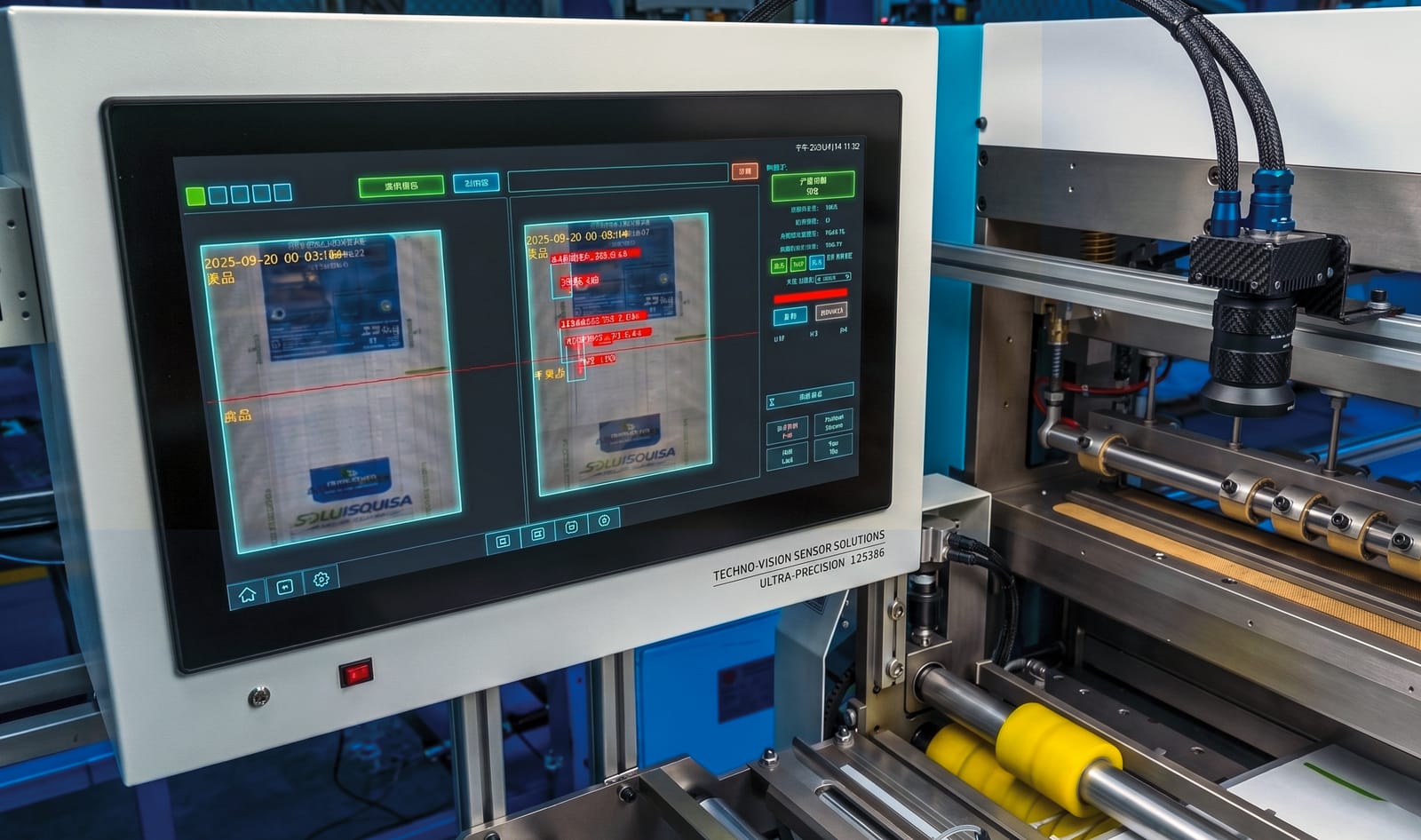
You do not need a new machine to get AI inspection: a retrofit adds industrial cameras, engineered lighting and an edge compute unit to the line you already run, integrating with the existing controls over standard industrial protocols — OPC-UA, Modbus or MQTT. A typical project runs assessment → few-shot model baseline built from around 50 reference samples → installation → validation on your live product. No cloud connection is required at any stage. This guide walks through what actually gets installed, what you need to prepare, and where the honest limits are.
What gets installed
Three hardware groups, all at the machine:
- Cameras. On a continuous web the natural choice is line-scan cameras synchronised to an encoder, building a seamless image of the moving fabric; area cameras suit discrete stations such as post-cut bag inspection. Placement is decided by your defect history — a camera watching for print faults lives after the last print station, one watching stitch quality lives at the sewing head.
- Lighting. The component that decides more projects than camera resolution. Woven PP needs light geometry engineered for its texture; BOPP-laminated fabric adds gloss that demands careful angles and, where needed, polarisation. Lighting is engineered per installation, not bought off a shelf.
- Edge compute. An industrial PC or embedded AI accelerator mounted at the machine runs all inference locally, with near-zero latency. Production images and data stay on site — there is no cloud dependency, which also means the system keeps working when the factory network does not.
How it connects to your machine
Integration happens over the industrial protocols your controls already speak — OPC-UA, Modbus, MQTT — and comes in escalating depths, chosen with you rather than imposed:
- Alert-only (where most deployments start): defects raise an HMI alert and are logged with images. Operators keep full authority. This stage builds trust and establishes the real false-alert rate on your product.
- Flag-and-reject: detected defects mark bags for downstream rejection, so faults leave the process without stopping it.
- Line-hold on persistent faults: where the control system allows it, a fault that recurs past a threshold can hold the line — the alert that becomes an action.
The retrofit is engineered case by case for the specific machine and process — Rey Long does not promise universal compatibility, because honest integration depends on what your controller exposes and where cameras can physically live. The assessment settles both before any hardware is ordered.
What you prepare (it is less than you think)
- ~50 reference samples per SKU of known-good product — the few-shot baseline the model learns "normal" from. These can be collected during ordinary production.
- Your defect examples — kept reject bags, claim photos, anything. The model benefits, but more importantly the project does: defect history decides camera placement and tuning priorities.
- Machine documentation — controller type and available interfaces, so integration depth can be scoped accurately.
What you explicitly do not need: an internet connection to the line, a data science team, or thousands of labelled defect images. The few-shot approach exists precisely because factories do not have training datasets lying around.
What changes for operators
The working change is that operators stop staring and start responding. The system watches every bag; the operator answers alerts, judges edge cases and runs changeovers. The system is specified to shift the supervision ratio from one operator per two machines toward one per four — a staffing change, not a staffing cut, and one that moves people off the task they are least suited to. A Sandia National Laboratories study of visual inspection reliability found inspectors correctly rejected 85% of defective items and incorrectly rejected 35% of acceptable ones — sustained manual inspection loses on both sides at once. That study was on precision machined parts rather than packaging, so read it as an analogy for a bag line, not a measurement of one. The comparison is laid out honestly in the manual-vs-AI guide.
A bonus that shares the hardware: running recycled material
The same edge platform carries a second capability that has nothing to do with cameras: recycled (PCR) resin brings unstable melt flow and tensile strength, which surfaces as breaks and dimension drift at speed. The AI tension-control loop senses the micro-variations that instability produces and adjusts line speed and sealing temperature on the fly to keep bags inside their strength spec. For factories moving to higher recycled content — which increasingly means everyone — this is often the capability that justifies the project on its own.
The honest limits
Three boundaries worth stating before any purchase order:
- Recall is a commissioning result, not a datasheet number. The 95%+ defect-recall target is application-dependent — fabric, artwork, lighting and defect classes all move it — and it is validated on your product during commissioning. See what AI inspection catches and misses for what the numbers mean.
- Detection is not correction. The system alerts on print faults; closed-loop colour registration correction is not a deployed capability — the vision-to-servo loop that does ship corrects cut and seam length via Eye-Mark, toward ±1 mm against roughly ±5 mm of practical drift on fixed-length cutting.
- Timelines are scoped, not quoted. A retrofit on a machine with a modern PLC and clean camera access is a different project from one on a twenty-year-old line with a proprietary controller. The assessment exists to tell you which one you have.
The short version
An edge AI inspection retrofit is cameras, engineered light and an industrial computer bolted to the machine you already own, talking to controls you already have, learning your product from about 50 samples you can collect this week — with no cloud, no data team and no new machine. Start alert-only, let it earn trust, deepen the integration when it has. The prerequisite is not budget approval; it is knowing your defect history well enough to point the cameras at the right problem.
Send Rey Long your machine type and defect history for a case-by-case assessment.
Frequently asked questions
Can AI inspection be added to machines Rey Long did not build?
Often yes, but it is confirmed case by case rather than promised in general. The system integrates through standard industrial protocols — OPC-UA, Modbus, MQTT — so the practical questions are whether your machine's control system exposes one of those interfaces (or can be given one), and whether there is physical space for cameras and lighting at the right point in the web path. Send the machine make, model and controller type and Rey Long's engineering team will assess it.
Does the retrofit require stopping production for long?
The physical installation — mounting cameras, lighting and the edge unit, and wiring into the control interface — is planned around your production schedule, and the model baseline is built from reference samples that can be collected during normal running. The honest caveat is that commissioning ends with a validation phase on the live line, tuning recall and false-alert behaviour on your actual product, and that phase needs the line running your real jobs. Total project timeline is scoped per machine rather than quoted generically.
What data do I need to prepare before a retrofit project?
Three things, none of them exotic: around 50 reference samples of good product per SKU (the few-shot baseline), whatever examples of past defects you have kept — physical bags or photos both help — and your defect history: which faults occur, how often, and what each one costs you. The defect history matters most, because it decides camera placement and which defect classes the system is tuned to prioritise. Machine documentation (controller type, available interfaces) rounds out the assessment.
Does the system stop the machine when it finds a defect?
That is an integration decision made with you, not a fixed behaviour. The lightest integration raises an alert on the HMI and logs the event; a deeper integration can flag bags for downstream rejection or, where the control system allows it, hold the line on a persistent fault. Most deployments start alert-only — it builds operator trust and establishes the false-alert baseline — and add automatic actions once the system has earned confidence on your product.
Does edge AI inspection help when running recycled (PCR) material?
Yes, through a separate capability that shares the same edge hardware: recycled resin has unstable melt flow and tensile strength, which causes breaks and dimension drift at high speed. The AI tension-control loop senses the micro-variations that instability produces and adjusts line speed and sealing temperature automatically to keep the bag within its strength spec. As brands push recycled content upward, this is increasingly the capability that pays for the hardware — inspection rides along on the same platform.