· Updated
Print Registration Drift on PP Woven Fabric: A Diagnostic Guide
By the Reylong Engineering Team
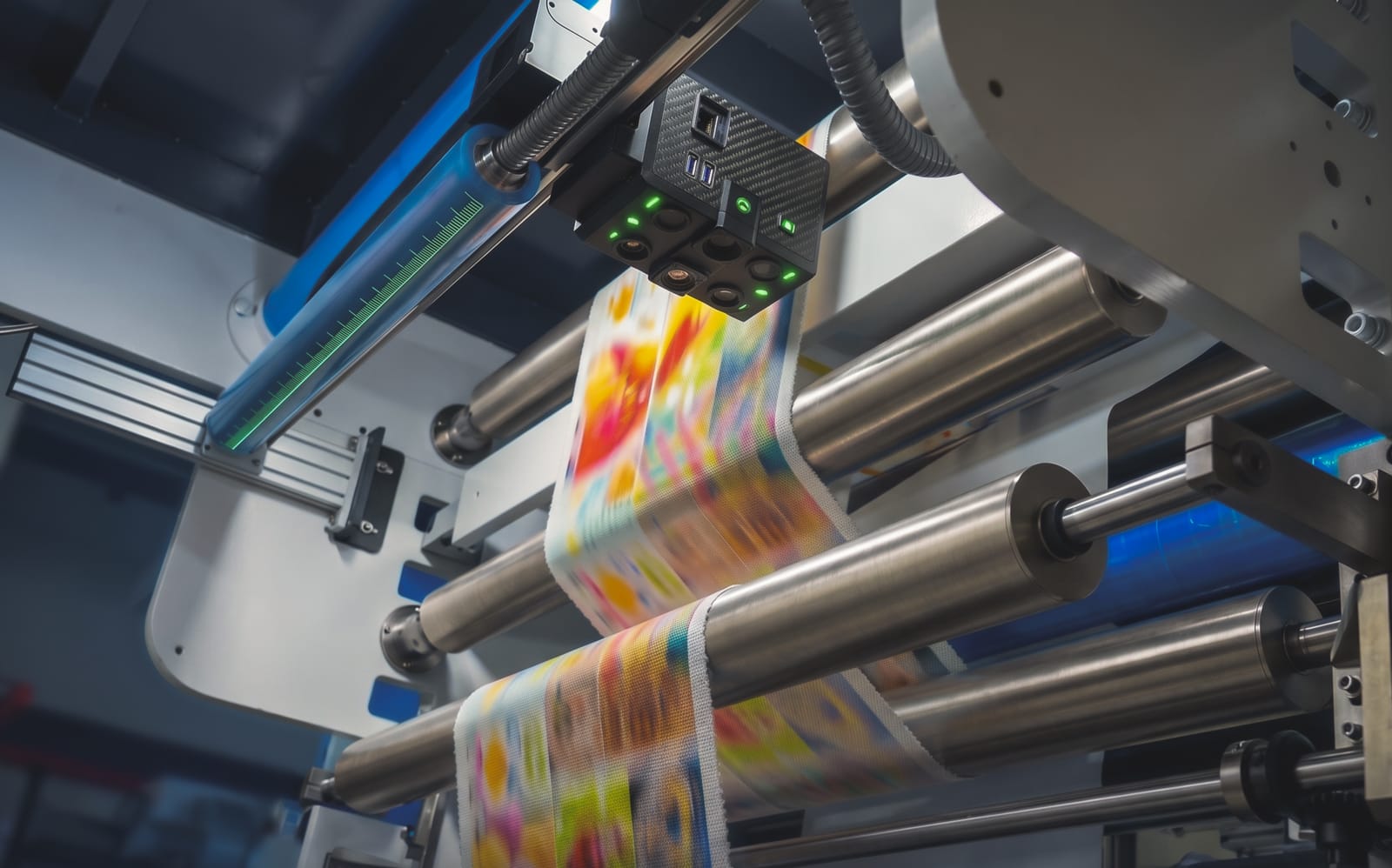
On PP woven fabric, print registration drift is a web tension problem in most cases — not a printing problem. Woven PP stretches under tension, so the web arriving at the last colour station is no longer the length it was at the first, and every colour after that lands out of position no matter how well the plates are mounted. This guide walks the diagnosis in the order that finds the cause fastest — tension first, then anilox and plates, drying, web path and humidity — explains what the JLRPM-6800BO/6C does to hold registration, and states plainly what AI can and cannot do about it today.
Why registration is harder on woven PP than on film
Most flexo troubleshooting advice is written for film or paper. Woven polypropylene breaks the central assumption behind that advice: that the web arriving at station 6 is the same length as the web that left station 1.
It is not. Woven PP is a textile. It is built from extruded tapes crossed in warp and weft, and it behaves like a fabric under load: it stretches, it stretches differently along and across the weave, and the amount it stretches depends on how hard you are pulling it. A tension difference between the unwind and the last print station does not just move the web — it changes the web's length. Every colour after that lands on a substrate that is no longer the size the plate was made for.
This is why registration on woven PP is primarily a tension problem wearing the costume of a printing problem. Chasing it in the print unit — remounting plates, swapping anilox rollers, adjusting impression — is the most common way to spend a shift and fix nothing.
Diagnose in this order
Work from the cause that is most likely and cheapest to check toward the one that is least likely and most invasive. Resist the urge to start with the plates just because the defect is visible in the print.
1. Web tension profile, unwind to rewind
Map the tension at every zone, not just the setpoint on the HMI. You are looking for two things: a tension that is too high overall (stretching the fabric), and a tension that varies as the roll runs down. The second is the sneakier one. As roll diameter decreases, the inertia and the effective torque-to-tension relationship at the unwind change; if the taper is not compensated, tension climbs or falls through the roll and registration drifts with it. A defect that is clean at the start of a roll and bad by the end of it is a tension-taper signature, not a plate problem.
2. Anilox rollers and printing plates
Only once tension is proven stable does it make sense to look here. Check for a worn or plugged anilox (which changes ink film weight, and therefore apparent register at the edges of a solid), plate mounting error, plate swelling from solvent attack, and uneven impression pressure. Excess impression pressure is worth singling out: bouncing the plate harder into the fabric to "get better coverage" deforms both the plate and the web, and it will smear registration while appearing to solve a density problem.
3. Inter-color drying
If a previous colour is still wet when the web reaches the next nip, friction at that nip becomes unpredictable and registration wanders. Drying is speed-dependent, so this fault often appears only above a certain line speed — a press that registers perfectly at 60 m/min and drifts at 100 m/min is telling you the ink no longer has time to set.
4. Web path and guiding
Check idler rollers for wear, contamination and free rotation; check that rollers are parallel and the web is not being steered laterally into the nip. A single dragging idler introduces a local tension spike that no amount of central tension control will see.
5. Ambient humidity and static
Last, but check it before you accept "the machine is worn out". Humidity drives static generation on the running web, and a charged web does not behave consistently at the nip. If your registration quality tracks the season rather than the job, this is where the answer is.
How the JLRPM-6800BO/6C is built to hold registration
The press cannot make woven fabric behave like film, but it can remove the machine-side variables so the ones that remain are the ones you can act on:
- Servo-driven tension control across the web path — the single most important control on woven PP, for the reasons above.
- Six independent ceramic anilox rollers, one per colour station, metering a consistent ink volume regardless of press speed, so ink film weight does not drift as you change speed.
- Inter-color drying between every station, with 18 kW of inter-color heating, so each colour is set before the next one is laid on top of it.
- Four print configurations (0+6, 1+5, 2+4, 3+3), printing one or both sides of the fabric in a single pass — fewer passes means fewer chances to reintroduce tension error.
- 100 m/min maximum printing speed, with a printing repeat length of 350–1300 mm and a maximum printing width of 770 mm.
What AI vision does today — and what it does not
This is where the industry conversation gets loose, so it is worth being exact.
What ships today. Rey Long's AI-Powered Machine Intelligence runs a CNN vision model on edge hardware at the machine, inspecting output at full line speed. It detects printing defects — registration drift, ink skip, blur — alongside material and stitching defects, at 95%+ defect recall, and it alerts the operator the moment a recurring fault appears, before a whole batch is scrapped. It deploys few-shot, building a working baseline from as few as around 50 reference samples, and it retrofits onto existing machines over standard industrial protocols (OPC-UA, Modbus, MQTT). In practice this converts registration drift from a problem you discover on a finished pallet into one you are told about on the second bag.
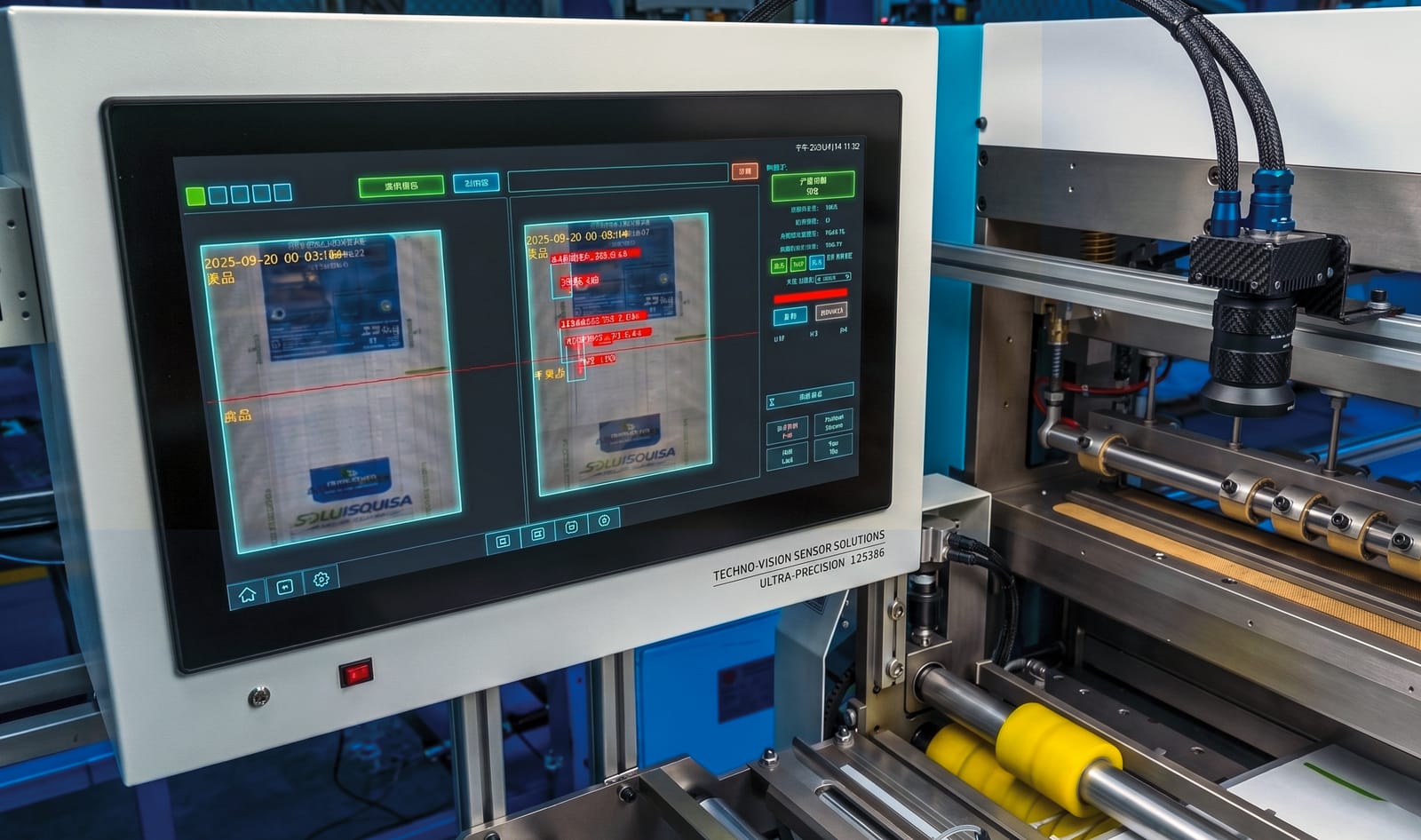
What does not ship today. Closed-loop correction of colour registration — vision measuring the drift and driving the servos to null it out with no operator in the loop — is not a Rey Long capability. It is a direction the industry is moving in, and it is one we are actively exploring, but we are not going to describe an intention as a product. When it exists, it will be documented with real numbers on real fabric.
One distinction matters here, because the two are easy to conflate: Rey Long does run a vision-to-servo closed loop today, in Dynamic Error Compensation. Vision reads the Eye-Mark on each segment, calculates the real deformation of the running web, and corrects the servo drives on the fly — but it does so to tighten cutting and sewing accuracy, toward a ±1 mm target against roughly ±5 mm on conventional fixed-length cutting. That is a length problem, not a colour-to-colour alignment problem. The mechanism is closely related; the application is not the same, and it would be dishonest to present one as the other. We cover it in detail in the cut-length guide.
The short version
On woven PP, registration drift is a tension problem until proven otherwise. Map the tension profile through the roll before you touch a plate. Then check anilox and impression, then drying, then the web path, then the room. A press with servo tension control, per-station ceramic anilox and inter-color drying removes the machine's contribution to the error; AI vision, today, tells you within seconds when the remaining error has crossed your limit — which on a line running 100 m/min is the difference between two scrap bags and two thousand.
Talk to Rey Long's engineering team about registration on your fabric and artwork.
Frequently asked questions
What causes print registration drift on PP woven fabric?
In most cases the fabric itself, not the press. Woven PP is not a stable, isotropic web the way film is — it stretches under tension, and it stretches unevenly along the warp and weft. If the web is 0.2% longer at station 6 than it was at station 1, the sixth colour lands 0.2% out of position no matter how perfectly the plate is mounted. Tension variation is therefore the first thing to check, followed by anilox and plate condition, inter-color drying, web path alignment, and ambient humidity. Mechanical causes (a worn bearing, a mis-mounted plate) are real but far less common than tension.
Can AI correct print registration automatically?
Not yet — and it is worth being precise about where the industry actually is. Rey Long's CNN vision system inspects every bag at full line speed and detects registration drift, ink skip and blur with 95%+ defect recall, alerting the operator the moment a recurring fault appears. That is detection and alerting, and it ships today. Closing the loop — feeding that vision measurement back into the servo drives to correct registration without human intervention — is a direction the industry is moving in and one Rey Long is actively exploring, but it is not a deployed capability and we will not claim otherwise. Rey Long's vision-to-servo closed loop that does exist today corrects cut and seam length via Eye-Mark, which is a different problem.
How tight can registration tolerance realistically be on woven PP?
Automatic register control systems on film presses are typically specified around ±0.1 mm. Woven PP will not hold that, because the substrate itself deforms: the achievable tolerance depends on fabric denier, weave density, lamination, tension profile and line speed, and it is properly established by trialling your actual fabric rather than quoted from a datasheet. The practical goal on woven PP is a registration error that stays stable and within your print design's trapping allowance — which is why designers of woven-bag artwork build in generous traps instead of relying on film-grade precision.
Why does inter-color drying affect registration?
A colour that has not set before the web enters the next print nip does two things: it transfers ink where it should not, and it changes the friction between the web and the next impression cylinder. Inconsistent friction means inconsistent web behaviour at the nip, which shows up as a registration error that seems to come and go with no obvious cause. Drying capacity is also speed-dependent, so a press that registers cleanly at 60 m/min can start drifting at 100 m/min purely because the ink has less time to set. The JLRPM-6800BO/6C carries an inter-color drying system between each of its six stations with 18 kW of inter-color heating for this reason.
Does humidity really change print registration?
Indirectly, yes, and it is the cause most often missed because it correlates with the season rather than with anything you changed on the machine. Polypropylene absorbs very little moisture, but humidity strongly affects static generation on the running web. A statically charged web behaves differently at the nip and can cling or lift unpredictably, and anti-static conditioning is one of the tacit adjustments veteran operators make by feel. If registration quality tracks the weather rather than the job, look at ambient humidity and static control before you look at the press.