· Updated
What Is Eddy Current Separation? Recovering Non-Ferrous Metals from Recycling Lines
By the Reylong Engineering Team
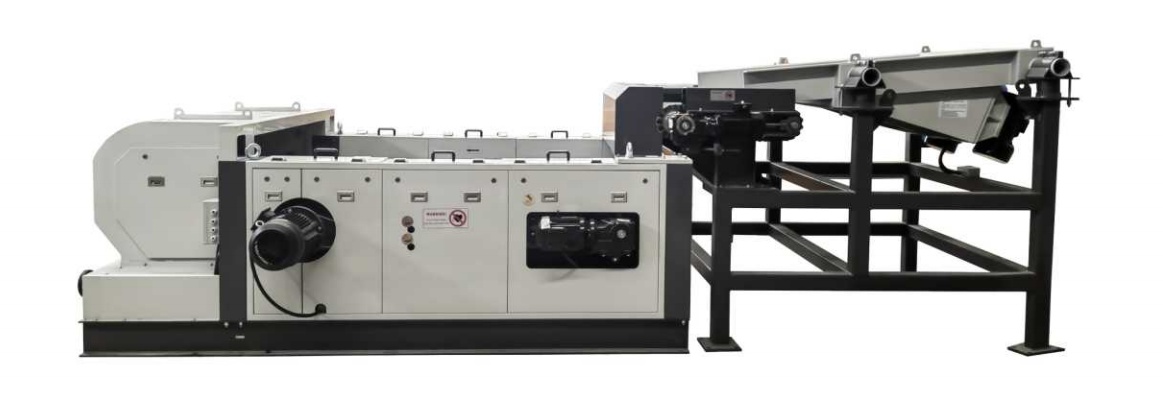
Eddy current separation is an electromagnetic sorting technology that recovers non-ferrous metals — such as aluminum, copper, and brass — from mixed material streams. It is a core process in plastics recycling, electronic waste (e-waste) handling, and post-industrial material recovery.
It matters most after shredding. When scrap such as cables, electronic waste and end-of-life plastic products is shredded, valuable copper, aluminum and brass fragments end up mixed into the plastic. An eddy current separator is what pulls those non-ferrous metals back out — recovering the metal and cleaning the plastic in a single pass.

How Does an Eddy Current Separator Work?
The separator uses a rapidly rotating magnetic rotor inside a non-metallic conveyor drum. As conductive non-ferrous metal particles pass over the drum, the alternating magnetic field induces electrical currents — called eddy currents — within the metal. These eddy currents generate an opposing magnetic field that creates a repelling force, propelling the metal away from non-metallic materials like plastic, glass, or paper.
What Materials Can Be Separated?
- Copper fragments and granules from cable and wire shredding lines
- Aluminum and copper bits liberated from shredded e-waste and mixed plastic scrap
- Brass fittings from demolition and scrap streams
- Aluminum caps and foil from plastic bottle recycling and packaging lines
What Eddy Current Separation Cannot Do
The same physics that makes the process work also sets its limits. Austenitic stainless steel conducts poorly enough that it behaves almost like inert material and stays in the reject stream. Very fine fragments carry too little induced current relative to their air drag, so below roughly the machine's stated minimum particle size recovery falls away regardless of field strength. Metal still enclosed in plastic — a copper conductor inside un-stripped insulation, or a foil layer bonded inside a laminate — is not seen as metal at all, because the fragment as a whole is not free to be thrown. Liberation upstream therefore sets the ceiling on what any separator can recover.
Why Is Eddy Current Separation Important?
Non-ferrous metals are valuable commodities. Recovering them from shredded plastic and mixed waste streams generates direct revenue while improving the purity of the downstream plastic recyclate — a double payback. For facilities processing post-consumer or post-industrial waste, an eddy current separator is typically one of the highest-return pieces of equipment on the line.
Reylong Eddy Current Non-Ferrous Metal Separator Line
Reylong manufactures a complete Eddy Current Non-Ferrous Metal Separator Line designed for integration into existing recycling and sorting plants. It recovers aluminum, copper and brass from shredded plastic, e-waste and mixed scrap, with adjustable rotor frequency for different particle sizes, a high-throughput belt design, and a compact footprint suitable for retrofitting into existing facilities (throughput depends on material type and fragment size).
Contact our team to discuss specifications and capacity requirements for your facility.
Matching the Separator to the Feed
Two settings do most of the work when commissioning a line. Rotor speed fixes how rapidly the field alternates: faster suits small, light fragments, slower suits larger and heavier ones, which is why a plant running a single mixed feed usually accepts a compromise rather than an optimum. Belt speed then decides how long each fragment stays inside the field and how far it has to travel to clear the splitter. Getting both wrong in the same direction is the usual reason a machine that meets its rating on a test sample underperforms on real plant feed.